
From Incarceration to Higher Education: How One Woman’s Journey Shows Why Access to College in Prison Matters
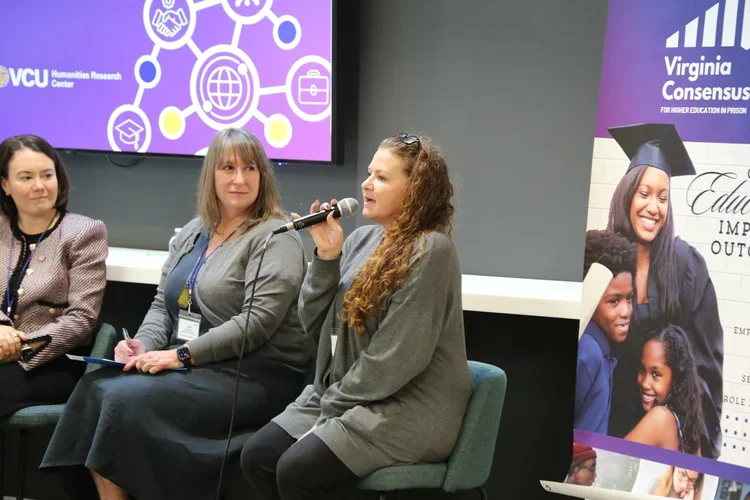
Pictured left to right: Nicole Overley, Panelist; Julie Little, Panelist; Kelly Dara, Panelist
During the Digital Opportunities Summit, Kelly Dara talked about accessing education while incarcerated, speaking from firsthand experience. Dara was incarcerated for nearly three decades, most of that time at the Fluvanna Correctional Center for Women. During those years, she earned her associate degree at Piedmont Virginia Community College, enrolled in entrepreneurship courses and stayed committed to continuing her education long after release.
Today, she is a graduate, an advocate, and a master’s degree student at Syracuse University. Her journey is a powerful reminder of what’s possible when education is treated not as a privilege, but as a pathway to hope, dignity and second chances.
The Urgency of Technology Access
Pursuing an education while incarcerated is filled with obstacles most students will never experience. Dara experienced how limited access to technology can impact the learning process.
Professors face constant rule changes, security delays and unexpected barriers just to enter the facility. Dara recalls taking a geology course where even bringing in rock samples became a logistical challenge. In another research-heavy class, students had no access to the internet. Instead, they filled out handwritten request forms, which their professor carried back to a campus library, printed into packets and mailed back into the prison, hoping the materials matched the student’s topic. If they didn’t, the process started all over again.
Even typing a paper was a challenge. Out of a facility housing roughly 1,200 women, only five computers were available in the library. Students signed up for just one hour at a time. Writing a five-page paper meant rushing through notes, typing without spellcheck and often having no time to fix even small errors. Many professors accepted handwritten papers, knowing how limited access truly was, but even that meant spending days rewriting assignments just to ensure they were legible.
Despite these hurdles, Dara described professors and students who kept showing up. “Instructors found creative workarounds and accepted handwritten assignments,” said Dara. “Students remained determined and so hungry for knowledge – eager for the connection that education brings.”
Navigating the Challenges of Reentering Society
When Dara returned home in 2024, she immediately began pursuing a bachelor’s degree. But experienced a new set of obstacles.
Her first choice was to attend a traditional university. The application required a background check, multiple interviews and repeated explanations of the conviction she had already spent nearly 30 years paying for.
“Somebody who has never met me, who knows you from a piece of paper, is going to decide whether or not you're allowed to step on campus,” Dara said. “The process was discouraging.”
Just days later, she applied to Southern New Hampshire University, an online program. Within three days, she was accepted. No background check. No barriers. Just opportunity.
For Kelly, that moment represented dignity. A recognition that her future should not be defined by the worst moment of her past.
The Experiences That Shape Reform
Dara’s story demonstrates what is at stake and what is possible. Education did not just prepare her for a career. It restored her sense of purpose. It gave her a future she could believe in.
As Virginia continues working to expand access to higher education in prisons, stories like Dara’s show why this work matters. Education reduces recidivism, strengthens families, stabilizes communities and transforms lives. Every new program, every expanded partnership and every investment in correctional education represents another door opening for someone who deserves the chance to walk through it.
“Education behind those walls isn’t just about learning,” Kelly shared. “It’s about hope. It’s about being seen as more than a number. I know firsthand that education can change lives, because it changed mine.”
Her journey isn’t just a success story—it’s a call to action. And it’s one we cannot afford to ignore.